
Websites
Shopify
A/b testing
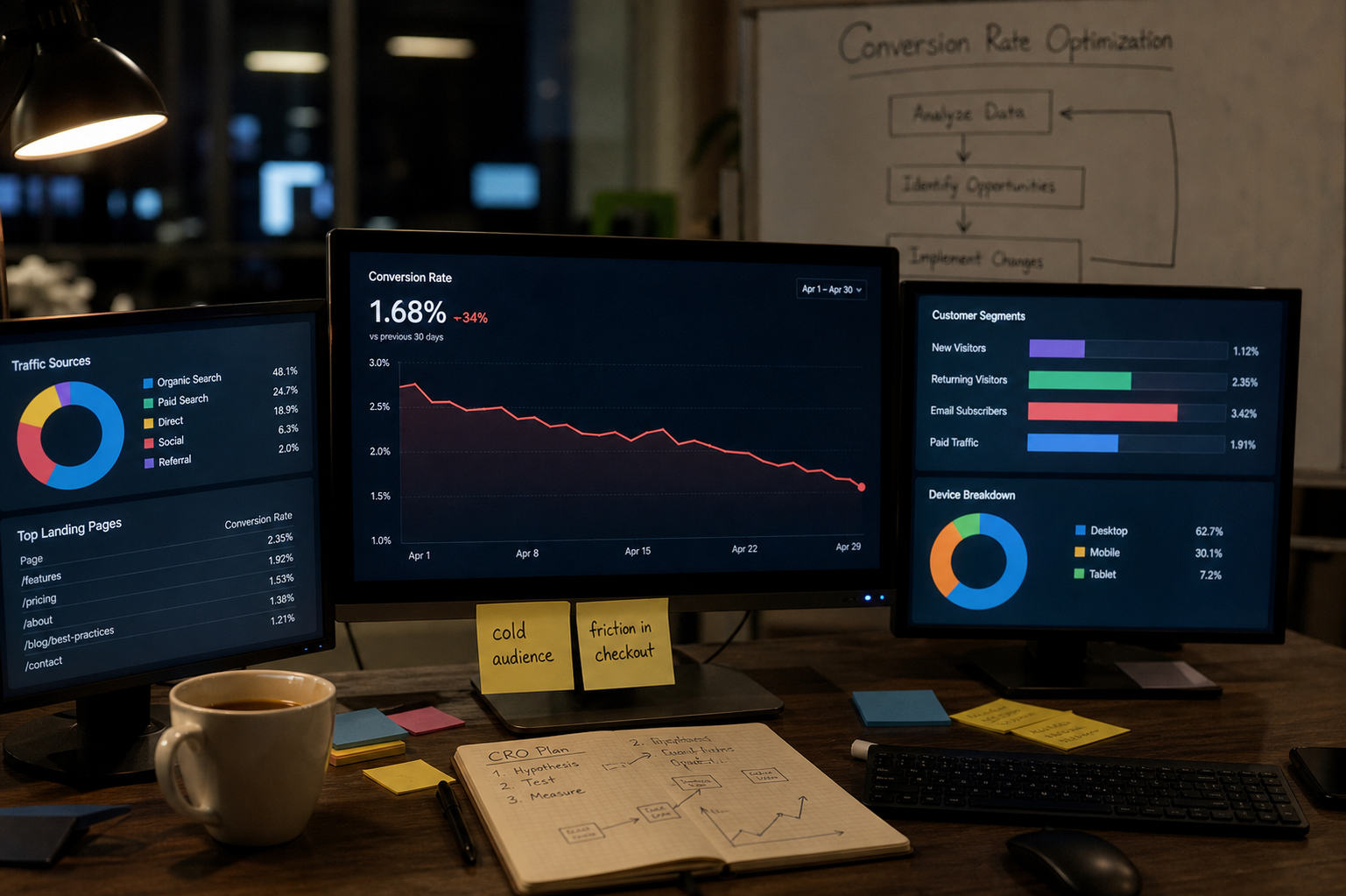

Your ad spend hasn't changed. Your product hasn't changed. But your Shopify conversion rate has dropped, and now you're refreshing analytics every hour trying to figure out why.
Here's the uncomfortable truth: most of the time, a conversion rate drop isn't one dramatic thing. It's one of a handful of usual suspects — and the fix almost never starts with "redesign the site" or "spend more on ads." It starts with finding out exactly where the drop is happening.
A sudden Shopify conversion rate drop almost never has one single cause. It's usually a combination of a few things happening at once — which is exactly why guessing at a fix is so risky. Before any of that, it's worth knowing that a chunk of "conversion rate suddenly dropped" cases aren't real drops at all — they're a tracking or attribution issue making the numbers look worse than they are. It's one of the first things we rule out before touching anything else, because there's no point fixing a problem that doesn't exist.
Once you know the numbers are real, the drop is usually coming from one or more of these:
As you scale ad spend, you naturally reach people who don't know your brand yet. That's not a reason to pull back on ads — it's a signal that your site needs to do more of the convincing that a warm, familiar audience used to do for free. If your homepage and product pages are written for people who already trust you, a colder visitor lands, doesn't get what they need fast enough, and bounces. That's a site problem, and it's fixable.
Confusing copy, an unclear value proposition, too many steps between "interested" and "checkout," or a page that doesn't answer the question a visitor actually has. This isn't something that broke — it's something that was never quite right, and it costs you a percentage of every visitor who was on the fence. Finding and removing it is exactly the kind of thing that moves a conversion rate back up.
A new app, a theme update, or a checkout config change can cause very specific, very costly problems, a discount code that silently stops applying, a payment button that fails on one device, a form field that misbehaves on iOS. These are easy to miss because they usually only affect one device, browser, or payment method, and you won't notice unless you're segmenting your data.
Not every drop is internal. Category demand moves throughout the year, and it's worth ruling out before you touch anything on-site.
Before you panic and start redesigning pages, rule these out first. Most "mysterious" conversion drops have a findable, fixable cause and most of those causes live on your site, not in your ad account.
The average conversion rate you see in Shopify is hiding the actual problem. A drop of 10% across the whole store could mean almost anything, a genuine issue affecting everyone equally, or a much sharper problem hitting one small slice of your traffic that's dragging the average down.
The real answer only shows up once you cut the data properly: by device, by channel, by geography, by new versus returning customers, by the exact step in the funnel where people are leaving. A drop that only shows up on one device usually means a rendering or checkout bug. A drop in one channel usually means something about the traffic that channel sends you. A drop isolated to new visitors points somewhere completely different to a drop in returning customers.
This is the part that takes real time and the right tools to get right, and it's exactly the kind of analysis that separates "we think it's the ads" from actually knowing. Guess wrong here and you can spend months and thousands of dollars fixing something that was never broken.
Shopify's own benchmark puts the average store conversion rate at around 1.4%, with 3.3%+ considered strong. But that number moves a lot by category, high-consideration products (furniture, tech, luxury) sit lower, impulse and repeat-purchase categories (beauty, supplements) sit higher. Compare your store against your own history and your category, not against a generic industry average.
Once you've found and fixed the issue, most founders stop there. That's the mistake.
Chasing conversion rate is the wrong long-term goal in the first place. You can hit a record conversion rate by discounting everything 40% and still make less money than last month. Conversion rate doesn't care about profit, it just counts how many clicks turned into orders.
The number that actually tells you if you're making more money from the traffic you're already paying for is revenue per visitor (RPV): conversion rate × average order value.
That's the only metric that captures both how many people buy and how much they spend. A store can "fix" its conversion rate and still be worse off if every order is smaller and less profitable than before. This matters even more when cost of living pressure is pushing customers to spend less per visit, that's a real, external factor, but it's not something you have to just absorb. If people are still buying but spending less, the fix isn't a lower conversion rate target, it's giving them a reason to add more to their cart or trade up. It's why a Shopify CRO agency focused purely on conversion rate can hand you a "win" that actually costs you money, and why increasing average order value matters just as much as the conversion rate itself.
If you're doing over $1M a year on Shopify and you're still making changes to your site on gut feel, every change is a bet with real money attached — either you test it, or you gamble with it.
The reason most "best practice" fixes don't move the needle for seven-figure Shopify stores is that they were built for someone else's traffic, someone else's price point, someone else's customer. A tweak that doubled someone else's conversion rate might do nothing for you. The only way to know is to test it against your own traffic.
This is the loop we run as a Shopify growth agency for $1M+ Shopify brands, including a number of Australian Shopify stores scaling past seven figures:
Every 2–4 weeks, we run that loop again. Find the leak, fix it, prove it, repeat — so your ad spend actually pays off instead of running through the same leaks it did last month.
If your Shopify store is doing $1M+ a year and your conversion rate has dropped, or your ad spend keeps climbing without revenue per visitor following it, that's exactly the kind of leak we look for.
Book a free RPV Opportunity Call, a 60-minute walkthrough where we identify 3–5 specific revenue opportunities on your store.
It's rarely truly "no changes." The most common causes are colder traffic from scaling ad spend that your site isn't yet built to convert, friction somewhere in the user journey, a drop in average order value, a seasonal demand shift, or sometimes a tracking issue making a healthy store look like it's declining. Which one applies depends on properly segmenting the data by device, channel, geography, and funnel step — which is exactly the diagnosis we run for $1M+ Shopify brands before recommending any fix.
Shopify considers roughly 1.4% average and 3.3%+ strong, but this varies significantly by category — high-consideration purchases convert lower, impulse and repeat-purchase categories convert higher. Compare against your own historical baseline and your specific category rather than the overall average.
No — not before you know why it dropped. Increasing ad spend adds more traffic through the same funnel. If the funnel has a leak, more traffic just means more money running through that same leak.
Not on its own. Conversion rate can go up while profit goes down, for example if you increase sales through discounting. Revenue per visitor (conversion rate × average order value) is a more accurate measure of whether your traffic is actually becoming more valuable.