Ecommerce
Shopify
DTC brands

Every founder can tell you their revenue to the dollar. Ask them what they actually keep as profit from each order, after every cost, and the room goes quiet.
Revenue is a vanity number. The truth of how a business is doing is decided by six percentages sitting underneath it, and most brands have never worked out what theirs are.
.png?width=768&height=432&name=The%20Math%20of%20eCommerce%20(2).png)
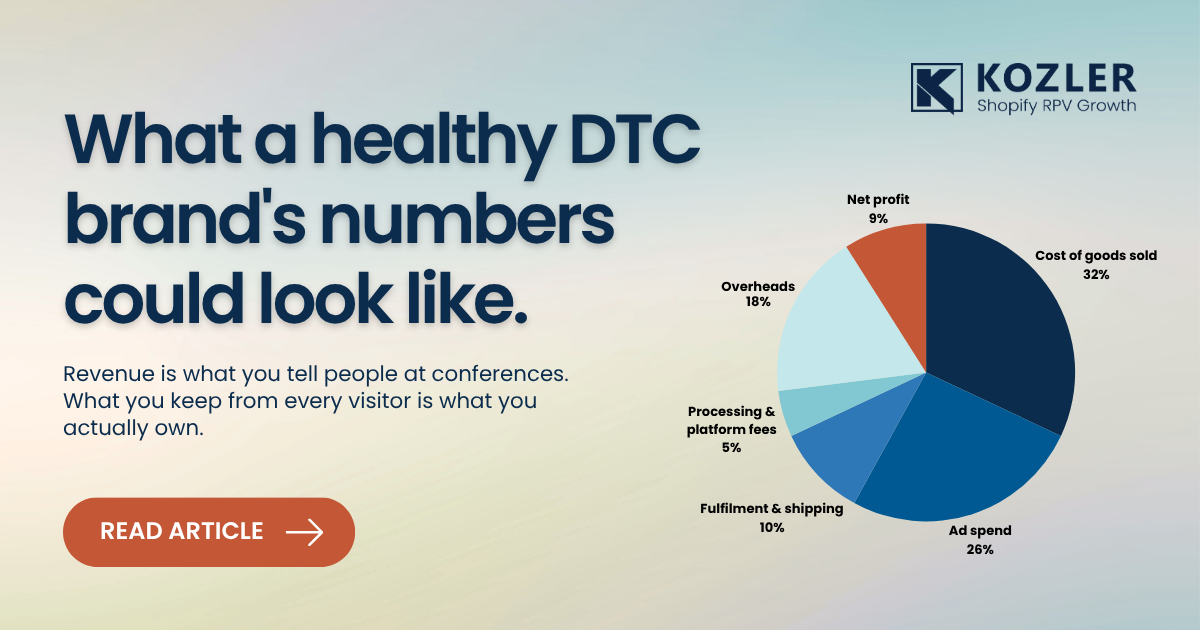
In this example nine cents on the dollar is profit. That's a good outcome in this industry: a brand with its costs under control, priced properly, and buying customers efficiently.
Let's break down each of the expenses you face. Most brands get at least two of these six numbers wrong, and if you don't know where your money is going, you can't fix it.
The cost of goods sold (COGS) is what you paid to have the product sitting in your warehouse ready to ship.
That's more than the factory invoice. Landed COGS includes inbound freight, customs duties, packaging, co-packing and any stock you write off. Most brands leave at least one of those out and understate the line by 8–15% as a result.
The brands that scale profitably sit at the bottom of that range. Push past about 55% and running ads is not a great idea, because there isn't enough left in the order to pay for the customer who bought it.
Get this number wrong and every number below it is wrong too.
Ad spend is everything you pay companies like Meta, Google and TikTok to get someone onto your store.
This is the line that has moved hardest over the past few years, and always in the wrong direction. Around 59% of eCommerce companies now put more than 30% of revenue into advertising, and the cost of winning a new customer has risen 222% over the past decade.
What makes it dangerous is how fast it moves. ROAS (return on ad spend) is how much revenue you get back for every dollar you put into ads. At 4x, ads cost you 25% of revenue. At 3x, 33%. At 2x, 50%.
A drop from 3x to 2x doesn't shave a little off your margin. It takes about 17 points of it, which is more than most brands make in a year.
This is everything it costs to get the order out the door and into the customer's hands: picking, packing, warehouse fees and the delivery itself.
Shipping alone runs 8–12% of revenue, higher if your product is heavy or bulky. This is why offering free delivery needs to be a careful decision.
Then there are returns, which is where most brands get this line wrong. Around one in five online orders comes back, and closer to one in three in fashion. A return doesn't just cancel the sale: you may pay the freight in both directions, someone has to inspect the item, and it may not be sellable again. If you're treating returns as a shipping cost rather than a hit to your margin, your profit is overstated.
Every time a customer pays you, someone takes a cut. Card processing runs 2.5–3.5%, with Stripe and Shopify Payments both sitting around 2.9%. On top of that sits your platform subscription and every app bolted onto it, which adds another one to three points.
Selling through a marketplace changes the maths entirely. Amazon's combined fees can take 25–40% of the order before you've spent a cent on ads.
Almost nobody bothers to negotiate these fees, which is a mistake. Unlike every other cost here, reducing it has no downside: you sell exactly the same amount and keep more of it.
Overheads are the costs that don't move when your orders go up or down. Rent, salaries, accountants, insurance and your own drawings.
Note what isn't here. Warehouse storage and third-party logistics fees belong in fulfilment, not overheads. Counting them twice is one of the most common ways a P&L stops adding up.
Smaller brands can run much higher than 10–15%, because the bill is the same whether you sell $2M or $10M.
Net profit is what's actually yours. Every cost above has been paid, and this is what's left of the dollar.
Be clear that profit is not cash. A profitable brand can still have nothing in the bank, because the profit is sitting in a shipping container somewhere. The median brand waits around 130 days between paying for stock and being paid for it. Profitable brands can still run out of money.
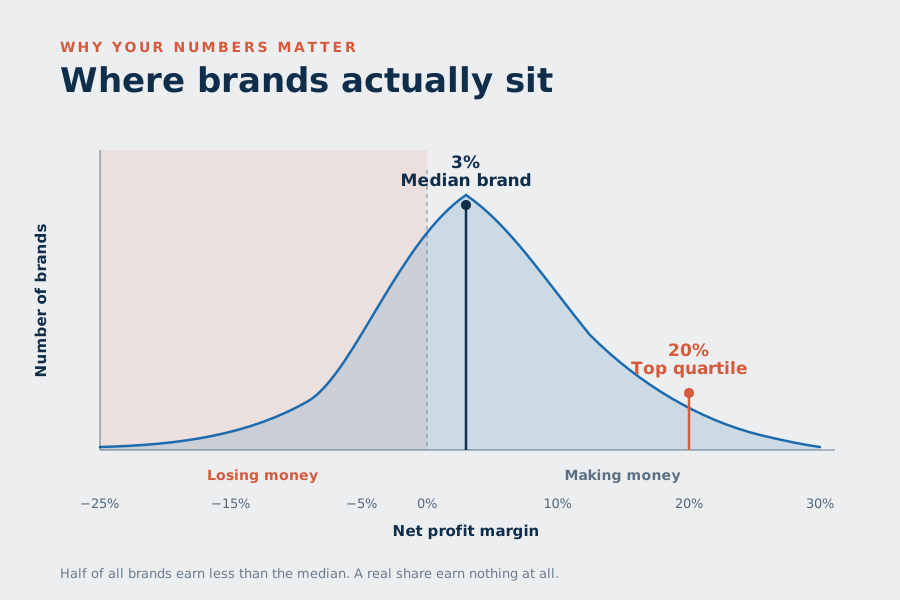
The median brand earns a 3% net margin. Half of all brands earn less than that, and a real share of them earn nothing at all.
Three percent on a $5M brand is $150,000 for a year of inventory risk, ad spend, staff and stress.
The gap between that and a brand keeping 10% isn't luck, and it usually isn't scale. It's getting more out of the money you're already spending: the ads you've already paid for, the overheads you're already carrying.
That's why Kozler believes increasing your revenue per visitor is the easiest and the most important thing you can do to scale in eCommerce.
You'll notice every credible benchmark quotes a median, not an average. That's deliberate.
The median is the brand standing in the middle of the line-up, half above and half below. The average is total profit divided by the number of brands. When some brands are at 25% and others are at −20%, the average stops describing anybody. It's a number no real business earns.
So if you've been measuring yourself against an "average" net margin you read somewhere, you've been measuring against a statistical artefact. The median is the honest comparison, and the median is 3%.
Net profit is a result. You can't reach in and change it; it's whatever falls out the bottom once the other expenses have taken their share.
What you can move is the money left over from each order after the costs that rise and fall with that order: product, fulfilment, fees and the ads that won the customer. Every one of those is on the list above, and every one of them is a decision rather than a fact.
That's the number to manage. If it's healthy, growth compounds: each extra order puts cash toward the rent and the salaries, and once those are covered the rest is yours. If it's thin, growth is just a faster way to run out of money.
You cannot fix a number you have never calculated, so it's time to do your calculations.
Now the part that changes the number.
Ad costs are going up. CPMs climb every year and the cost of winning a customer is up 222% over the past decade. None of that is reversing.
But here's what doesn't change: you pay for a visitor whether they buy or not. Meta charges you for the click either way. Your rent and salaries are the same this month regardless of how many of those visitors convert.
Which means rising ad costs don't weaken this argument, they sharpen it. The more expensive traffic gets, the more expensive it is to waste. A visitor who leaves without buying cost you exactly the same as one who bought.
Take 10,000 visitors a month, 2% of them buying, a $75 average order: $15,000 in revenue, of which you'd keep around $1,350. Now lift that conversion rate to 2.4%. Not double. Four-tenths of one percent. Same traffic, same ad budget, same rent.
Your profit goes from $1,350 to $2,790. It more than doubles.
Compare that to buying your way there. Growing revenue 20% by spending 20% more on Meta gets you the same top line and barely moves your profit, because the cost went up alongside it. You bought turnover, not margin.
The other three levers have a floor. You can only cut costs so far, and every cut has a downside: a cheaper product, a smaller team, a worse experience. Revenue per visitor has no ceiling and no downside. The traffic is bought, the rent is paid, the stock is in the warehouse. Everything that visitor needs in order to buy has already been paid for. The only question left is whether your website closes them.
We work on one number for Shopify brands: revenue per visitor. Not more traffic, and not conversion rate on its own, because conversion rate can be bought with a discount, and a discount just means more parcels for the same money.
The process is a loop. We dig into your data and customer journey to find where the revenue is leaking. We prototype new versions of the pages, offers and flows that matter. Then we A/B test them against what you're running now, roll out the winners, kill the losers, and go again. Each pass stacks on the last.
Doing that properly takes more than one skill set, so the team covers the whole journey: conversion copywriters, UX specialists, designers, Shopify developers, A/B testing experts and an offer strategist.
We guarantee at least a 10% lift in revenue per visitor within 90 days. If we don't hit it, we keep working for up to another 90 days at no extra cost.
Revenue is what you tell people at conferences. What you keep from every visitor is what you actually own.
Book a free 60-minute walkthrough we'll go through your store and show you 3–5 specific revenue opportunities. No charge, and you're free to act on them yourself.
|
+22%
Average lift in revenue per visitor in the first 90 days, measured across 100+ Shopify stores.
Want that lift on your store?
Book an RPV opportunity call and we'll audit your home, collection, product, cart and checkout flows, then walk you through the 3–5 highest-impact leaks we find. Free, and yours to keep either way.
Book your RPV opportunity call
For Shopify brands at $1M+ a year and 600+ orders a month. Not a fit for pre-product-market-fit or dropshipping.
|